

Exercise Cobra Warrior 25-2

The key stone exercise Cobra Warrior (CW) second edition of 2025 saw an interesting mix of aircraft arriving in the UK to make this exercise as complex, realistic and challenging as possible.

Overview of Cobra Warrior
Group Captain Paul Hanson, head of operations and training at the Air and Space Warfare Centre (ASWC) explained the background and importance of Cobra Warrior to the RAF and its participants. ‘Cobra Warrior is One of the most complicated and integrated exercises in Europe with between 60 -80 fast jets and other aerial assets in the air space at one time.’ Up until this point RAF Weapons Instructors and their equivalent in the other forces, have learnt to master their own aircraft, at Cobra Warrior, in the live environment we bring them together in a multinational force to integrate them at a higher level with the navy, land forces and other international partners, but also looking at other domains including cyber effects and in space.’ Group Captain Hanson continued ‘We look to see how we can take these tactical experts and turn them into people who can fuse, sequence and synchronise effects across all aspects of the environment, so that the sum of all the parts that are at play, equal something you can get advantage in a time and space of your choosing, so you can bring the decisive effect of the airpower.’
The 300 soldiers as part of the land forces during Cobra Warrior provide added support by finding and designating targets whilst using drones to collect intelligence and pass this information to the aerial assets.
Post mission the ‘John Collier Facility building exercise control facility (at RAF Waddington) is used as a secure environment that is networked to all the locations across the UK where participants are based, which means we can don’t have to co-locate everyone in one place to do the learning. They dial in via a classified link and see the fight in real time and watch the debrief, seeing the mission unfold live, seeing the effects from weaponry used and what role they played in the mission and see how the whole jigsaw fits together.’
25-2 Participants
160 Royal Canadian Air Force (RCAF) personnel took part in Cobra Warrior arriving at RAF Waddington with eight CF-188 Hornets and a single CC-130HT. The Hornets were from the 425 Tactical Fighter Squadron, based at CFB Bagotville, Quebec, with the CC-130HT being from 435 Transport & Rescue Squadron from CFB Winnipeg, Manitoba.
In addition to the RCAF, RAF Waddington also played host to eight German Air Force Eurofighters Taktisches Luftwaffengeschwader 74 at Neuburg Air Base.
The Royal Air Force (RAF) provided a diverse mix of aerial assets from most of the RAF’s frontline squadrons. RAF Coningsby Typhoon FGR4s from three squadrons participated, these were 3, 11 and 29 Squadrons. Typhoons from RAF Lossiemouth were also part of CW involving three squadrons 2, 6 and 9 squadrons. Also RAF Lossiemouth were 42 Squadron Poseidon MRA1s. F-35Bs from RAF Marham were in fewer numbers this year due to most of the aircraft being away on board the Royal Navy aircraft carrier Prince of Wales. RAF Brize Norton provided the tanker and transportation for the exercise with all three aircraft being involved in different parts of CW. These included Airbus Voyager KC2/3s of 10/101 Squadrons, Boeing C-17A Globemaster IIIs of 99 Squadron and Airbus Atlas C1s of 30 and 70 Squadrons. The movement of land forces used the venerable and highly important RAF Odiham Chinooks of 18 Squadron, whilst RAF Waddington 51 Squadron’s Boeing RC-135Ws General Atomics Protector RG1s of 31 Squadron provided electronic warfare and signals intelligence and UAS capability.
The land forces were supported by other helicopter assets form 845 and 847 Naval Air Squadrons of the Fleet Air Arm flying Merlin HC4/4As and Wildcat AH1s with fire support and protection being provided by AH-64E Apaches and 3 Regiments of the Army Air Corps from Wattisham.
Other than the RAF based Typhoons, RAF Coningsby was the base for the Aeronautica Militare 9° Gruppo with six F-2000A. Although the aircraft were marked with a mix of different units.

The provision of Red Air and Electronic warfare is always essential in these large force exercise and this year’s CW was supported by Draken Aero L159Es, Dassault Falcon 20s and Diamond DA42s flying from Teeside airport. Based out of Wittmund in Germany Top Aces Douglas A-4N Skyhawks provided additional Red Air and GFD Learjet 35/36s helped support CW.
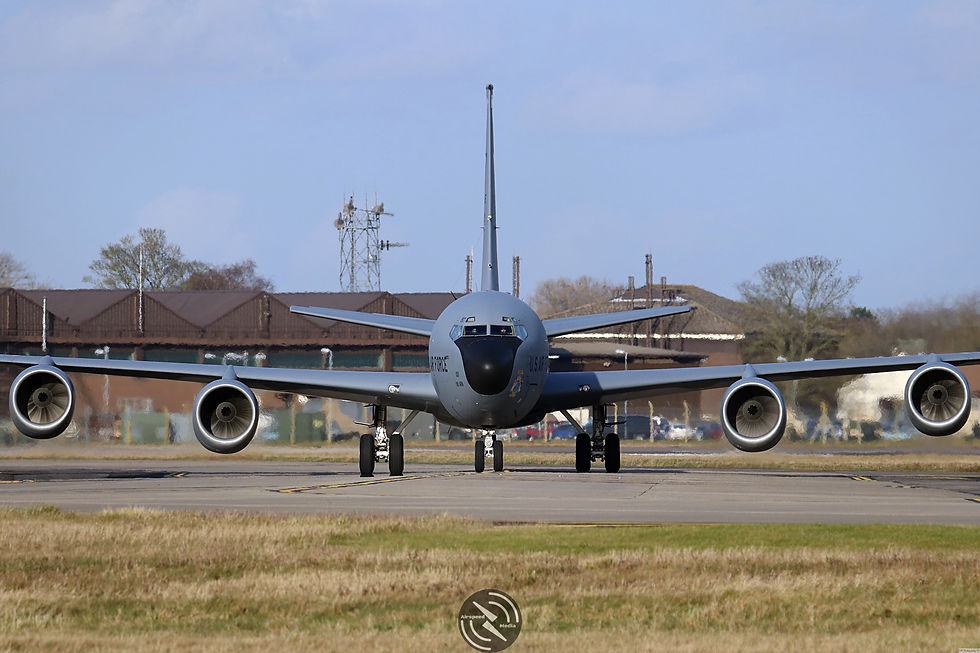
The USAF usually take part in CW with local assets from RAF Lakenheath and RAF
Mildenhall including the 48th Fighter Wing F-15Es, F-35As and the 100th Air Refuelling Wing KC-135s, refuelling the RAF Poseidon MRA1s, along with CV-22B Ospreys and MC-130J Commando IIs of the 352nd Special Operations Wing. But they also provided one of the oldest and most potent bombers in their inventory as a pair of B-52H Stratofortresses from the 307th Bomb Wing at Barksdale Air Force Base, Louisiana, flew in the CW missions for the first week. The Stratofortress has taken part in Cobra Warrior before, joining the exercise via round-robin missions from the US, though this is the first time the B-52H has flown in the exercise while temporarily based in the UK.
RAF Poseidon image USAF Senior Airman Katie Mullikin
Objectives met by particpants
307th Bomb Wing
“The primary objective of our mission during Cobra Warrior 2025 is to enhance interoperability with our NATO and allied partners while executing complex, multi-domain operations,” said Lt Col Kenny Squires, the 307th Bomb Wing’s deployed commander. “We’re here to train like we fight – in joint, coalition environments – so we can respond effectively to any threat, anywhere in the world.”
This is the second time the 307th BW has participated in a Cobra Warrior Exercise since 2019.
“The B-52 brings strategic reach and long-range strike capabilities to the fight. Exercises like Cobra Warrior 2025 ensure we keep a sharp edge,” said Squires. “For our team, it’s a chance to operate in a high-tempo, coalition environment away from home station and build readiness that underpins global deterrence. It also ensures our allies have exposure to heavy bomber integration and capabilities that they may not see regularly so that both of us are prepared for tomorrow’s challenges.”

Image courtesy of the U.S. Air Force
100th Air Refuelling Wing
“Cobra Warrior 25-2 demonstrates our commitment to the RAF and the combined force inside the alliance,” said Col. Scott Korell, 100th Operations Group commander. “With strong repetition and proficiency in operational integration at the highest levels we are able to build credibility and with credibility comes confidence and confidence then builds trust.”
“Exercise Cobra Warrior 25-2 gives us the reassurance of our abilities to perform in challenging and complex environments,” said Korell. “I am proud as the 100th Operations Group commander to lead such a fine group of professionals that stand ready anytime and anywhere to project air power.”
“Air refuelling is important for large-force employment exercises like Cobra Warrior because it allows increased flexibility for both fighter and mobility aircraft that are participating in the exercise,” said Capt. Daniel Coolbaugh, 351st ARS pilot. “It gives them more time on station and allows for more detailed planning for contingencies and other methods to achieve their objectives.”
Royal Canadian Air Force
“I’m incredibly proud of the entire Canadian Air Task Force team for their dedication and professionalism throughout the exercise,” stated Lieutenant-Colonel Maxime Renaud, Commander, Air Task Force COBRA WARRIOR 25-2. “They’ve integrated seamlessly with our allies and demonstrated Canadian proficiency in a demanding simulated scenario. Our CC-130HT Hercules crew, who delivered near one million pounds of fuel in-flight, was an essential contribution that kept our CF-188 Hornets in the fight and enabled mission success.”
The exercise served as a proving ground for tactical leadership development, where three RCAF fighter pilots graduated as Mission Commanders, a key milestone in the RCAF’s progression as tactical leaders within NATO’s air power framework. Behind the scenes, maintenance and support technicians from 425 Tactical Fighter Squadron, 433 Tactical Fighter Squadron and 435 Squadron worked tirelessly to keep Canadian aircraft mission-ready throughout the exercise.
Thank you to the Flight Lt Wallis and the RAF Media and Comms team for the opportunity to report on this important exercise


Comments